The greenhouse effect is the atmosphere surrounding the earth that protects all living things as it shields us from the sun’s rays. It also insulates the earth, retaining the heat of the day throughout the night. This is the greenhouse effect. Sun light is shortwave solar radiation that passes through this atmosphere. The earth absorbs this energy, heats up, and radiates it in the form of longwave infrared radiation. Greenhouse gases in the air absorb this energy and radiate it up into space and onto earth which warms Earth. The major greenhouse gases are water vapor, carbon dioxide, methane, nitrous oxide, and ozone. These gases are molecules made of atoms. Their molecular structures are as follows:
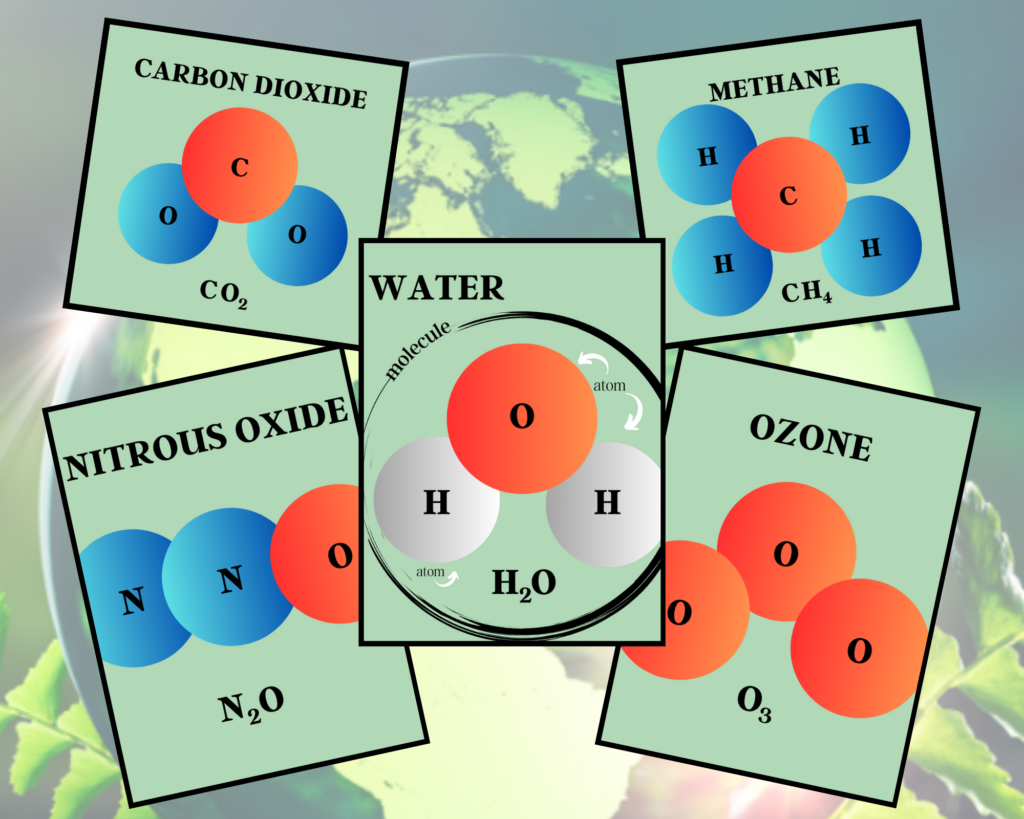
The Earth’s atmosphere is naturally balanced and gets out of balance when excessive greenhouse gases are emitted. According to the United Nations Intergovernmental Panel on Climate Change (UN IPCC), humans have caused climate change beginning more than a century ago simply by our lifestyle and the ways in which things are done that has increased the net greenhouse gas emissions. Again, this excess of greenhouse gases caused the imbalance of Earth’s atmosphere resulting in climate change and its ensuing problems of imbalance and dysfunction in all aspects of nature.
At this point, would you like to know how to help Earth through Simple Eco Actions that are simple and easy to do? If so, send an email to Support@EarthRescueMission.com.
“The IPCC [United Nations’ Intergovernmental Panel on Climate Change] was created to provide policymakers with regular scientific assessments on climate change, its implications and potential future risks, as well as to put forward adaption and mitigation options.” — in 1988.
Since its inception, the IPCC has prepared “comprehensive Assessment Reports about the state of scientific, technical and socio-economic knowledge on climate change, its impacts and future risks, and options for reducing the rate at which climate change is taking place. It also produces Special Reports on topics agreed to by its member governments, as well as Methodology Reports that provide guidelines for the preparation of greenhouse gas inventories.”
Included in the Synthesis Report on the IPCC Sixth Assessment Report (AR6), March 2023, is a graph shown below. Colored markings have been added. The red line indicates the year 1970 when the global surface temperature began climbing at a faster rate than previous years. The yellow highlights and blue arrow show the worldwide surface temperature increase during the 50-year span from 1970 to 2020.
“Global surface temperature has increased faster since 1970 than in any other 50-year period over at least the last 2000 years (high confidence).”
The United Nations Intergovernmental Panel on Climate Change (IPPC) Synthesis Report of the Sixth Assessment Report (AR6): Climate Change 2023, Longer Report, page 7
The UN IPCC also states in the AR6 Longer Report, page 10: “Human-caused climate change is a consequence of more than a century of net GHG emissions from energy use, land-use and land use change, lifestyle and patterns of consumption, and production.”
And that the net emissions worldwide has continued to rise despite the CO2 emission reductions resulting from fossil fuels and industrial processes (CO2-FFI), improvements in energy intensity of Gross Domestic Product (GDP) and carbon intensity of energy.
The UN IPCC reports that this has been due to the “rising global activity levels in industry, energy supply, transport, agriculture and buildings.”

- The 10% of households with the highest per capita emissions contribute 34–45% of global consumption-based household GHG emissions,
- The middle 40% contribute 40–53%, and
- The bottom 50% contribute 13–15%.
An increasing share of emissions can be attributed to urban areas (a rise from about 62% to 67–72% of the global share between 2015 and 2020).
The drivers of urban GHG emissions are complex and include population size, income, state of urbanisation and urban form. (high confidence).

The gross domestic product (GDP) is the monetary value of a country’s goods and services produced within a specific time-span. (InternationalMonetaryFund.org)
“Carbon intensity [of the gross domestic product] is the measure of CO2 [carbon dioxide] produced per dollar of GDP. In other words, it’s a measure of how much CO2 we emit when we generate one dollar in our economy.” (Energy.gov)
A decreasing carbon intensity is good for the earth and the economy. It means efficient energy use, including more people having jobs that burn less or zero fossil fuels; and the production and transport of goods to market and the consumer requires less or zero fossil fuels as well.
“Carbon intensity [of electricity] is a measure of how clean our electricity is. It refers to how many grams of carbon dioxide (CO2) are released to produce a kilowatt hour (kWh) of electricity.” (NationalGrid.com)
Energy sources using fossil fuels have a higher carbon intensity value whereby renewable energy sources such as wind, solar, and hydro power result in close to zero CO2 emissions, making these sources’ carbon intensity value lower and near zero.
“Carbon intensity varies by hour, day, and season due to changes in electricity demand, low carbon generation (wind, solar, hydro, nuclear, biomass) and conventional generation.” (CarbonIntensity.org.uk)
Carbon intensity of electricity changes at every moment in response to how much electricity we use and how it is produced. Electricity generated the conventional way via the burning of fossil fuels increases the carbon intensity of electricity value while the production by the sun’s energy or wind speed decreases the value.
If we had a family member or friend who was deteriorating each and every year at a steady rate, wouldn’t we intervene and figure out ways we could help them?
If our home were falling apart slowly with each passing year, wouldn’t we find ways we could fix and stop its decline?
Earth is our only home and we’re causing its decline. In addition, we’re disrupting and, at times, destroying the natural wild lives of animals and plants around the world. They are struggling, suffering, and dying. It’s ecological disintegration —- ecosystems of both land and waters being destroyed; biodiversity of species threatened and affected by extinction; and much more.
According to the IPCC, we as consumers have the power to reduce the severity of climate change by changing ourselves. By changing some of the ways we do things, we can turn the climate crisis around. It’s a matter of rethinking our lives; and what and how we do things, keeping in mind that some of these changes may be uncomfortable and at times, hard to imagine doing. However, as we work through this global problem together, can we, at least, keep an open mind?
In its Climate Change of 2022: Mitigation of Climate Change Report, the IPCC presents specific things we can do, specific changes we can make. According to the Oxford Languages, Google’s English Dictionary, “mitigation” means “the action of reducing the severity, seriousness, or painfulness of something.” It is critical and urgent that as many of us in the world adopt as many of these changes as soon as possible so we can decrease the severity and danger of climate change to benefit all. It’s for all the wildlife; land and foliage; oceans and its creatures; and us, human beings. Collectively as a global community, we can make a difference. We can change the course of Planet Earth.
What do you think? Are you ready? If so, send an email to Support@EarthRescueMission.com to get started.
References:
- Callen, Tim. “Gross Domestic Product: An Economy’s All.” International Monetary Fund. Finance and Development, https://www.imf.org/en/Publications/fandd/issues/Series/Back-to-Basics/gross-domestic-product-GDP#:~:text=GDP%20measures%20the%20monetary%20value,the%20borders%20of%20a%20country.
- Carbon Intensity API. CarbonIntensity.org.uk.
- The United Nations Intergovernmental Panel on Climate Change, ipcc.ch, https://www.ipcc.ch.
- Lee, Hoesung (chair) and The Core Writing Team. “AR6 Synthesis Report: Climate Change 2023.” IPCC.ch. March 2023, https://www.ipcc.ch/report/sixth-assessment-report-cycle/.
- Oxford Languages and Google. https://languages.oup.com/google-dictionary-en/.
- “What is carbon intensity?” https://www.nationalgrid.com/stories/energy-explained/what-is-carbon-intensity#:~:text=Carbon%20intensity%20is%20a%20measure,generated%20creates%20CO2%20emissions
- Wood, Daniel. “INTERACTIVE: Energy Intensity and Carbon Intensity by the Numbers.” Energy.gov, February 19, 2016. https://www.energy.gov/articles/interactive-energy-intensity-and-carbon-intensity-numbers.
- Woodward, John. Eyewitness Climate Change. London, Delhi, Penguin Random House, 2008, 2011, 2021.